
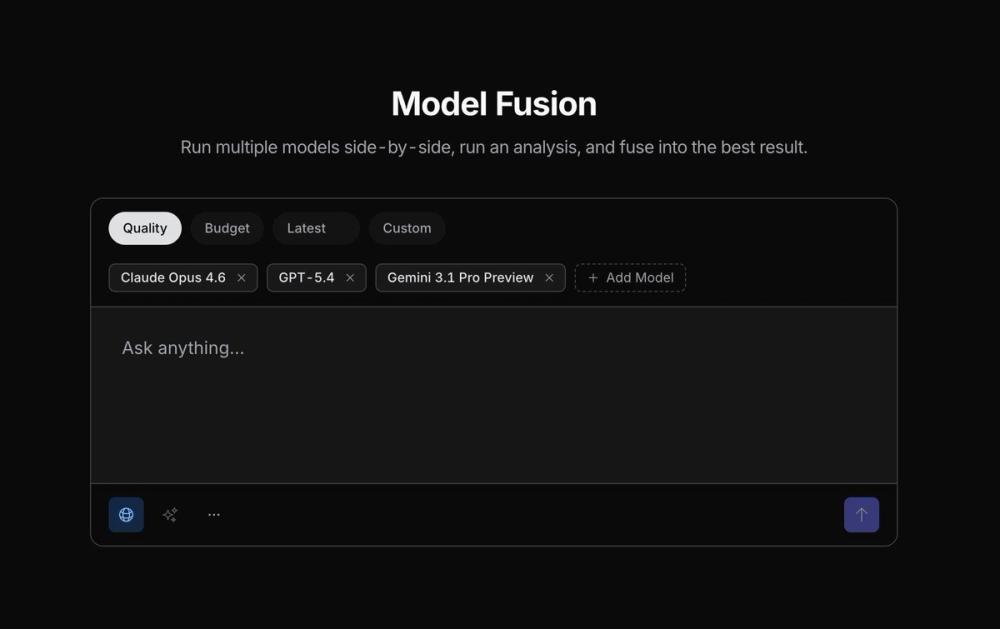
OpenRouter Model Fusion – The Best AI Model Aggregation Tool for Startups
Choosing the right AI model can be frustrating for startups and developers. One model may generate better reasoning, another may excel at coding, while a third performs better for speed or cost efficiency. Testing multiple models manually wastes time, increases API complexity, and slows down product development.
That’s where OpenRouter Model Fusion changes the game.
OpenRouter Model Fusion allows developers and businesses to run multiple AI models side by side and combine the best outputs into a single, optimized response. Instead of relying on one language model, teams can leverage the strengths of several leading AI models simultaneously to improve accuracy, reliability, and overall performance.
What is OpenRouter Model Fusion?
OpenRouter Model Fusion is an AI infrastructure solution designed to help developers orchestrate multiple large language models (LLMs) through a unified API layer. It enables applications to compare responses from different AI providers and intelligently fuse the strongest answers into one high-quality result.
Rather than locking your product into a single model ecosystem, OpenRouter provides flexible access to various AI models while simplifying model management and routing. Developers can experiment with different models, optimize output quality, and improve response consistency without building complex multi-model systems internally.
The platform is particularly useful for AI startups, SaaS products, automation tools, coding assistants, research platforms, and enterprise AI applications that require more reliable outputs. By combining strengths from multiple models, businesses can reduce hallucinations, improve reasoning quality, and create more accurate AI-powered workflows.
OpenRouter Model Fusion also helps teams optimize costs and performance by dynamically selecting or combining models based on specific use cases. Developers gain the flexibility to test, compare, and scale AI infrastructure without managing separate integrations for every provider.
For startups and agencies building advanced AI products, OpenRouter Model Fusion offers a smarter and more scalable approach to AI orchestration.
Key Features
-
Multi-model AI orchestration through a unified API
-
Run multiple large language models side by side
-
Intelligent response fusion for higher-quality AI outputs
-
Flexible model routing and provider management
-
Reduced hallucinations and improved reasoning accuracy
-
Easy integration for AI SaaS products and developer workflows
-
Scalable infrastructure for production-grade AI applications
Use Cases
For Startups
Build AI-powered products with stronger response quality by combining outputs from multiple models instead of depending on a single provider.
For Developers
Test, compare, and optimize AI models quickly without creating separate integrations for every language model provider.
For Agencies
Develop advanced AI solutions for clients while improving reliability, response quality, and workflow automation performance.
For SaaS Platforms
Enhance AI features such as chatbots, assistants, content generation, and automation systems using fused multi-model intelligence.
Pros and Cons
Pros
-
Improves AI response quality and reliability
-
Supports multiple AI providers through one API
-
Reduces dependency on a single model ecosystem
-
Simplifies AI experimentation and optimization
-
Useful for advanced AI workflows and production systems
-
Flexible infrastructure for scaling AI applications
Cons
-
May increase API costs depending on model usage
-
Advanced orchestration can require technical understanding
-
Response latency may vary when combining multiple models
Why Choose OpenRouter Model Fusion?
OpenRouter Model Fusion stands out because it focuses on maximizing AI output quality rather than forcing teams to rely on a single model. By allowing businesses to compare and combine responses from different providers, it creates a more intelligent and flexible AI infrastructure layer.
For startups, this means faster experimentation and better-performing products. For developers, it reduces integration complexity while enabling sophisticated multi-model workflows. Agencies and SaaS companies can also improve AI reliability without building expensive orchestration systems internally.
Its unified API approach makes it easier to scale AI products while staying adaptable as the AI ecosystem evolves rapidly.
Alternatives Comparison
Some businesses manually integrate multiple AI providers or rely on single-model systems for simplicity. While those approaches may work initially, they often limit flexibility, increase maintenance complexity, or reduce output quality.
OpenRouter Model Fusion provides a more scalable and centralized way to orchestrate AI models while improving consistency and performance across AI-powered applications.
FAQs
What is OpenRouter Model Fusion used for?
OpenRouter Model Fusion is used to run multiple AI models together and combine the best responses into a single optimized output.
Is OpenRouter Model Fusion good for startups?
Yes. It helps startups improve AI output quality, reduce vendor lock-in, and accelerate AI product development.
Can OpenRouter work with multiple AI providers?
Yes. OpenRouter supports multiple AI providers through a unified API infrastructure.
Does OpenRouter Model Fusion improve AI accuracy?
Yes. Combining outputs from different models can improve reasoning quality, reduce hallucinations, and increase response reliability.
Is OpenRouter suitable for production AI applications?
Absolutely. It is designed for scalable AI orchestration and production-grade AI workflows.
Can developers compare AI models with OpenRouter?
Yes. Developers can test and compare model performance side by side to optimize outputs for specific use cases.
Does OpenRouter require advanced AI infrastructure knowledge?
Basic API knowledge is helpful, but OpenRouter simplifies much of the complexity involved in multi-model AI orchestration.


