Most SaaS companies fail because they chase tactics instead of building systems. Discover the framework behind predictable SaaS growth—from pain point analysis and channel selection to retention and expansion.
Too busy to submit manually?
We'll submit your startup to 100+ directories for you. Save hours of manual work.
What if we stack headings?
One month it's SEO. The next month it's paid ads. Then founder outreach. Then influencer partnerships.
Random activity creates random outcomes.
Predictable growth happens when a SaaS company builds a structured marketing system where acquisition, retention, and expansion reinforce each other over time.
The strongest SaaS businesses rarely depend on one channel. Instead, they create a framework that identifies customer problems, communicates solutions clearly, executes through the right channels, and continuously improves through data.
This guide breaks down that framework into a practical operating system for SaaS growth.
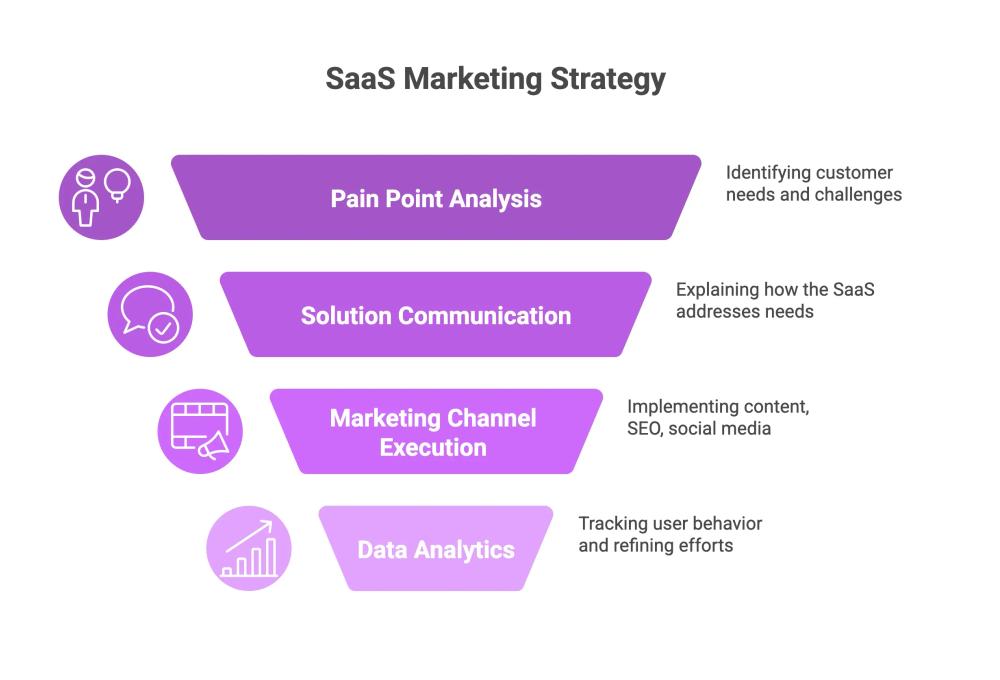
The first image illustrates a four-stage SaaS marketing system.
Unlike traditional funnels that stop at acquisition, this model creates a feedback loop.
Goal: Identify customer needs and challenges.
Everything starts here.
Many SaaS teams jump immediately into feature building or advertising before deeply understanding the customer's pain.
That creates messaging problems later.
Questions to answer:
Methods:
Without accurate pain point analysis, marketing becomes guessing.
Goal: Explain how the product solves customer needs.
Many SaaS companies describe features.
Strong companies communicate outcomes.
Bad messaging:
"AI-powered collaborative workflow automation"
Better messaging:
"Reduce weekly reporting time from 4 hours to 15 minutes."
Effective communication usually includes:
What problem do you solve?
Why should customers believe you?
Why choose you instead of alternatives?
Use the exact words users use.
People buy outcomes, not software architecture.
Goal: Reach customers where they already spend time.
Execution includes:
The biggest mistake is choosing channels based on trends.
Channels must align with company stage.
We will examine that shortly.
Goal: Track behavior and refine efforts.
Data transforms marketing from intuition into systems.
Track:
Growth compounds when data improves future decisions.
Without analytics, teams repeat mistakes.
The third image demonstrates an important reality:
The best channel depends on where you are—not what is currently popular.
| Stage | Primary Goal | Best Channels to Start | Weekly Metrics |
|---|---|---|---|
| Pre-PMF | Learn fast and acquire first users | Founder-led outbound, niche communities, directory listings, short demos | Qualified conversations, activation rate |
| Early PMF | Repeatable acquisition | SEO + content, directories, partnerships, lightweight paid tests | Trial-to-paid conversion, CAC payback trend |
| Growth | Scale efficient demand | Paid search, social, affiliates, integrations, review sites, programmatic SEO | Pipeline, payback, retention, expansion |
Before product-market fit, scale is irrelevant.
Learning speed matters.
Founders talking directly with customers receive:
This is difficult to obtain from SEO dashboards.
Founder-led outbound can include:
The goal is not volume.
The goal is understanding.
As SaaS businesses mature, manual growth approaches become bottlenecks.
Programmatic SEO becomes attractive because it creates scalable acquisition.
Examples:
Instead of publishing one article weekly, companies build systems that generate hundreds or thousands of targeted pages.
Examples:
This creates compounding search visibility.
Most founders obsess over acquisition.
Great SaaS businesses obsess over retention.
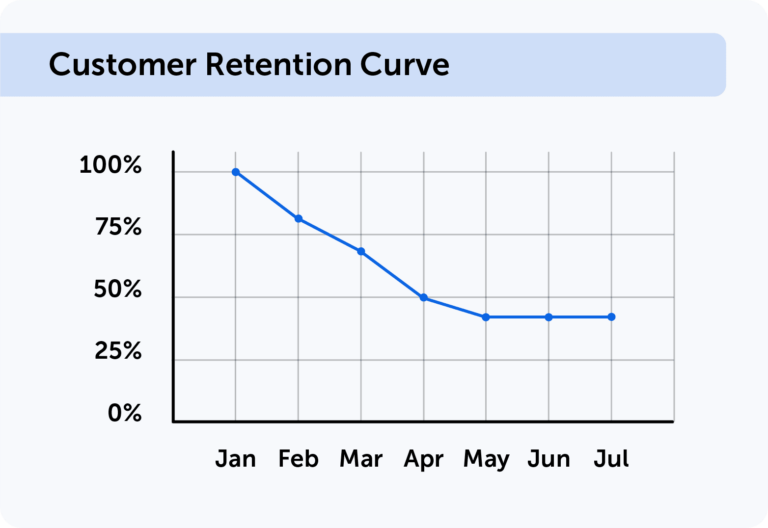
The customer retention graph shows a typical pattern:
That stabilization point is critical.
A flattening retention curve means a core group of users keeps receiving value.
The product becomes part of their workflow.
This changes economics dramatically.
If retention drops continuously:
If retention stabilizes:
This stabilization often reveals:
true product-market fit
Common causes:
Acquiring users with poor retention is like pouring water into a leaking bucket.
Track:
Retention should become a company-wide metric, not a marketing metric.
Growth doesn't stop after acquisition and retention.
The strongest SaaS businesses increase revenue from existing customers.
The fourth image illustrates that expansion requires collaboration between product and marketing.
| Expansion Happens When Customers | Marketing Supports This With |
|---|---|
| Invite teammates | Use-case campaigns for existing customers |
| Use more features | Feature education mapped to outcomes |
| Upgrade plans | Proof such as case studies and benchmarks |
| Buy add-ons | Referral loops, templates, shareable outputs, collaboration features |
Expansion increases:
This often creates growth even without large acquisition increases.
A collaboration SaaS product might:
Product team:
Marketing team:
Result:
Growth becomes self-reinforcing.
Founders can implement this framework immediately.
Rewrite:
Focus on outcomes rather than features.
Choose channels according to stage:
Pre-PMF:
Early PMF:
Growth:
Build a dashboard tracking:
Then identify:
Predictable SaaS growth is rarely created by hacks.
It comes from a repeatable system:
Understand pain → communicate value → execute channels → analyze data → retain users → expand revenue.
Companies that master this process stop chasing trends and start building growth engines.
That shift is what separates temporary traction from long-term SaaS success.